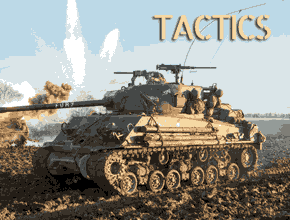
T34 Calliope (1944)
 Rocket-firing Tank, c100 converted
The T34 Calliope

Development of the M4 Calliope
The Rocket Launcher T34 Calliope was developed by the U.S. Ordnance Department in 1943. It arose from an Army requirement for mobile, high-volume fire support. The goal was to quickly suppress fortified German lines, trenches, and troop clusters prior to Allied infantry assaults.Watch this historical overview to see how the T34 Calliope system operated and deployed its immenseGeneral Design
Conceptual Design & Prototyping (1943)- The Concept: Engineers mounted a large, 60-tube rack atop the M4 Sherman turret. This allowed existing tank chassis to act as mobile artillery platforms. Mechanical Linkage: To avoid adding complex separate elevation gears, the launcher was connected via a mechanical arm to the tank's 75mm main gun barrel. Moving the main gun up or down automatically aimed the rocket tubes.The Tubes: Early prototypes used light, plastic launch tubes arranged in an upper bank of 36 and two lower groups of 12.
Operational Flaws & Crew Feedback: Gun Blockage: The original design's primary flaw was that the mechanical arm blocked the 75mm main gun from firing while attached. This left the tank defenseless against anti-tank threats.
Reloading Hazards: The 4.5-inch M8 rockets had to be manually reloaded from outside the vehicle. This process was slow and exposed crews to enemy fire, leading to a doctrine where empty launchers were simply discarded in combat.
Top-Heavy Profile: The massive rack drastically altered the Sherman's center of gravity. This made it dangerous to transport on landing craft, which famously led to its exclusion from the D-Day landings.
Evolutionary Upgrades (T34E1 & T34E2). Field Modifications: Tank crews began bypass-rigging the elevation arm directly to the top of the gun mantlet. This allowed the 75mm main gun to fire safely while the launcher remained attached.
The T34E1 Improvement: Ordnance officially integrated this fix by connecting the arm to the base of the gun mantlet. The plastic tubes were replaced with durable magnesium. This variant featured an easy-cut-off system so crews could instantly jettison the entire heavy rack.
The T34E2 Refinement: This final iteration optimized the electrical firing system, allowing a full 60-rocket salvo to be discharged in roughly 15 to 20 seconds from inside the turret.
Design of the Rocket System
 Launch Tubes: 60 total tubes arranged in a top bank of 36 and two bottom banks of 12 (plus side frames).
Rockets: 4.5-inch M8 solid-fuel, fin-stabilized rockets with a maximum range of roughly 4,200 yards.
Aiming: Attached via a pivoting mechanical arm linked to the Sherman’s 75mm main gun, allowing elevation using standard gun controls.
Firing: Triggered electrically via a cable running through the open commander's hatch.
The M8 rocket relied on tail-fin stabilization, whereas the later M16 rocket utilized spin stabilization achieved through canted nozzles. This fundamental shift in design significantly altered how the 4.5-inch weapons performed when ground-launched from systems like the M4 Sherman Calliope.
Launcher Rack Weight: 2,000 lbs (907 kg) (Weight of the 60-tube rack assembly when empty).
Rocket Weight (Each): 38.2 lbs (17.3 kg) (Individual weight of a single 4.5-inch M8 rocket).
Total Rocket Load Weight: 2,292 lbs (1,040 kg) (Combined weight of a full salvo of 60 rockets).
Salvo Duration: 15–20 seconds for all 60 rounds
Maximum Range: 4,200 yards (3.8 km)
Elevation Range: +25° to -5° (Linked to the 75mm main gun elevation)
| Comparison | ||
| Feature | Fin-Stabilised M8 Rocket | Spin-Stabilised M16 Rocket |
| Stabilisation Method | Four fixed or folding tail fins | Canted base nozzles that force rotation |
| Aerodynamics | Fin stabilization was inefficient at low, ground-launched initial velocities | Bullet-like spin stabilization maintained a tighter trajectory |
| Accuracy & Dispersion | Poor accuracy; required massive 60-tube barrages to ensure target coverage | Considerably tighter dispersion patterns and higher consistency |
| Maximum Range | Roughly 4,200 yards (3.8 km) | Upgraded to 5,250 yards (4.8 km). |
| Launcher Compatibility | Fired primarily from the T34 Calliope | Handled by upgraded launchers like the T72 |

Other Rocket-Launching M4 variants
There were three Rocket-firing versions of the M4:T34 Calliope: Most Famous in 1944 Fired up to 60 113 mm (4.45 in) (E1) or 183 mm (7.2 in) (E2) rockets.
T40/M17 Whizbang: A 1944 special demolition version equipped with a set of short-range 7.2″ HE rockets (183 mm).
Sherman Tulip: Two 3-inch (“60 lb”) RP-3 (76.2 mm) rockets on rails, 1st Coldstream Guards, Rhine offensive.
Specifications M4A1 Calliope | |
| Dimensions (L-w-H) | Same as M4 but height 5 meters+* |
| Weight | 35 tonnes |
| Crew | 4: Cdr, driver, Gunner and Loader |
| Propulsion | Same as M4 base chosen |
| Top speed | c35 kph |
| Suspensions | VVSS |
| Range | As M4, c400 km |
| Armament | Rocket Rack +coax. MG, Hull, 0.5 in. M1919A4, 75mm gun M1 in turret |
| Armor | Same as standard M4, depending on version |
The T34 Calliope in action

Operational Use - Combat Role: Built to suppress and overwhelm enemy infantry, trenches, and soft targets with sudden saturation fire.
Psychological Impact: Provided a massive psychological shock to opposing forces through intense noise, smoke, and concentrated blasts.
Drawbacks: Created a very tall profile that made the tank an easy target, and the heavy launcher setup could be jettisoned if standard tank combat was required.
The deployment of the M4 Sherman Calliope in the European theater was heavily shaped by logistics, weather, and shifting battle lines. While initially slated for the beaches of Normandy, it saw its primary action in the final push into Germany during late 1944 and 1945.
The Cancelled D-Day & Normandy Deployment (June 1944): The Plan: Designed to act as "bunker-busters" directly against German coastal fortifications.The Reality: Rejection by logistical commanders who feared the top-heavy, 60-tube design would capsize landing crafts during rough amphibious transport.
2. The Disrupted Ardennes Offensive (December 1944). The Plan: 30 tanks from the 743rd Tank Battalion were outfitted with T34 launchers. They were intended to support a major push through static German defenses on the Siegfried Line alongside the 30th Infantry Division. The Reality: The sudden German Ardennes Offensive (Battle of the Bulge) completely disrupted this operation. In the frantic shift to defensive maneuvers, the launchers were stripped off so the tanks could fight conventionally.
3. The Saarland Push & The Rhineland (February–March 1945) - The Breakthrough: The launchers were re-equipped under General Patton's Third Army. The Engagement: In late February 1945, a platoon from the 702nd Tank Battalion rolled through Körperich near the German-Luxembourg border. Tactical Role: Used during the Saarland push to fire massive barrages, softening fortified villages, roadblocks, and entrenched infantry.
4. The Final Drive into Germany (Spring 1945). Widespread Unit Use: By April 1945, limited numbers of Calliope attachments were integrated into various armor operations across the 2nd, 4th, 6th, 12th, and 14th Armored Divisions. Psychological Impact: While accuracy remained poor over distance, the terrifying shriek and explosive concentration of 60 simultaneous rocket impacts proved devastating to the morale of remaining German defenders.
Gallery
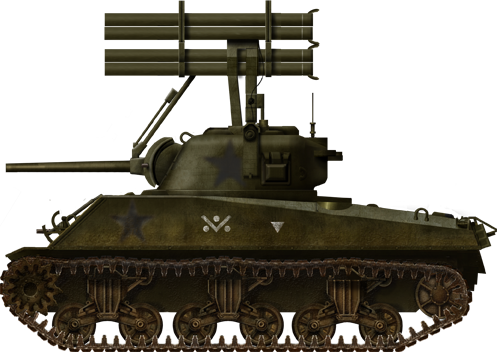
M4A3 Calliope in Germany, March 1945
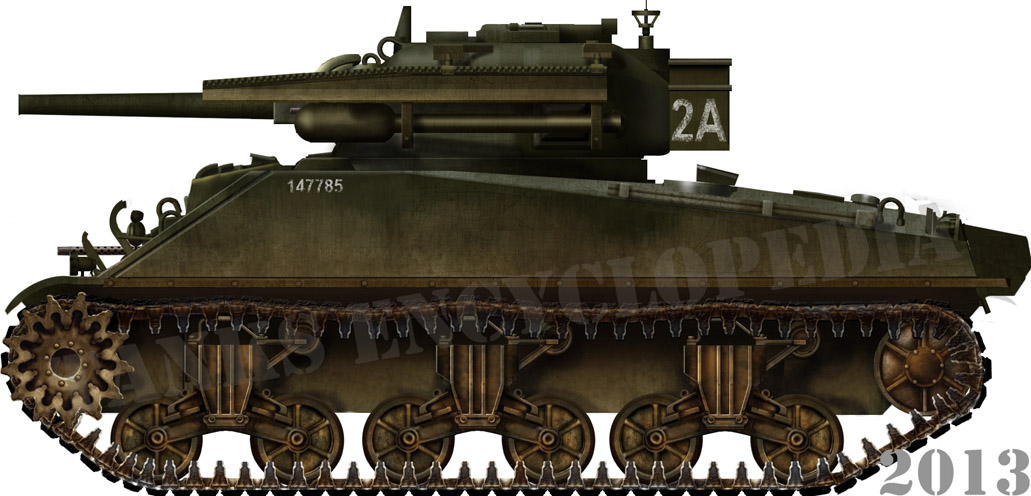
M4 Sherman V “Tulip” from the 1st Coldstream Guards, Rhine offensive, early 1945.


Read More/Src
Links
wikiVideos
WW2 Tanks


WW2 tanks posters
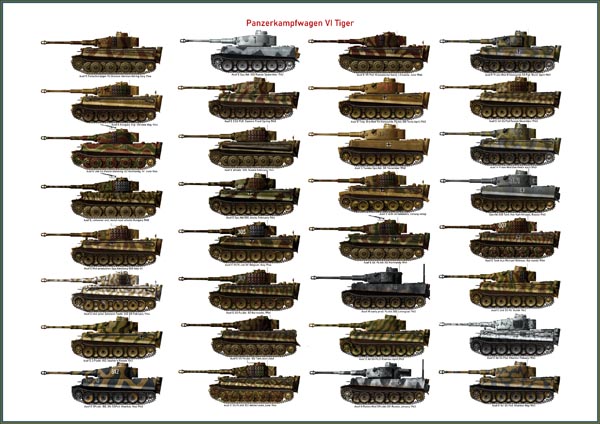
All Tiger tanks liveries.
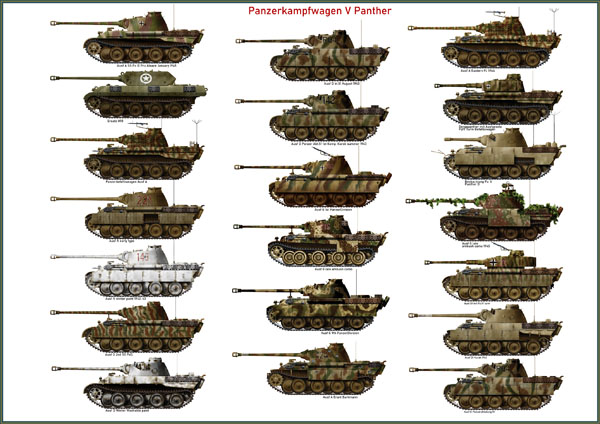
Panther liveries and variants
WW2 Armour - All tanks

Tanks aces and single tanks series
Find more there

Museums, Movies, Books & Games
The Tanks and Armor in pop culture
Tanks and armored vehicles in general are only really grasped when seen first person: The mass, the scale, it's all there. Explore also the way tanks were covered in the movie industry, in books and in video games.Movies:
Best tanks movie on warhistoryonline.com
On imdb.com
On bestsimilar.com/
miltours.com
liveabout.com/
watchmojo.com
Video Games:
pcgamesn.com
historyhit.com
levvvel.com
vg247.com/best-tank-games
mmobomb.com/
alienwarearena.com